
Sydney Virologist Explains Why Most People With Herpes Never Stop Having Outbreaks

Karen Hollis has spent 22 years studying how viruses outsmart the drugs designed to kill them.
Her work has taken her through university virology labs, a stint consulting for a major pharmaceutical company, and eventually into her own independent research practice in Sydney.
Along the way she built a database unlike anything else in Australia — 14,000 documented cases of herpes family virus reactivation, tracked against treatment protocols, lifestyle factors, and long-term outcomes.
Last month she published a research summary that quietly went viral in medical circles:
"After 22 years of data I can no longer pretend that antiviral prescriptions solve the herpes reactivation problem. They manage one pathway. The virus uses three. We've known this for a decade. Nobody talks about it."
The response from her colleagues was immediate.
So was the response from the 60,000 people who found it.
The Data That Started Everything
Hollis opens a folder on her laptop.
"I've been obsessive about outcome tracking since 2006. Every patient. Every protocol. Every follow-up."
She filters for active cases — people experiencing recurrent outbreaks despite being on or having tried antiviral treatment.
11,200 cases appear.
Antiviral Prescription Outcomes — 11,200 Cases
"One in five people gets full relief. That's the number nobody puts in the brochure," she says.
"And of those who do get relief? Most are back to managing symptoms within two years."
She clicks another tab.
Why Antivirals Stop Working — The Structural Problem
"The drug does what it's designed to do. But the virus has two other routes it can take. And we've been leaving both of them completely open."
The Virology Nobody Taught You
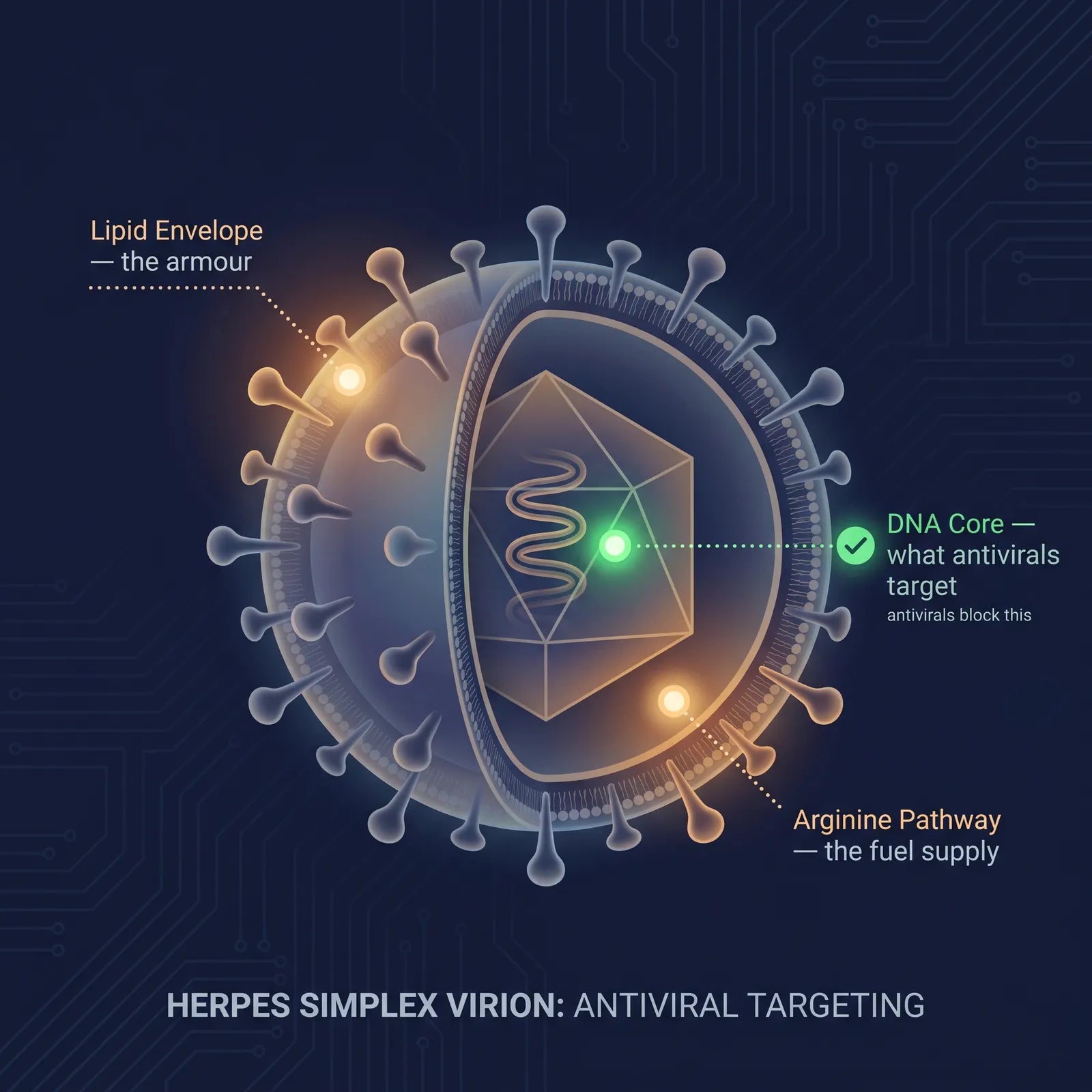
Hollis pulls up a diagram on her monitor.
"People think of herpes as a skin problem. It's not. It's a viral persistence problem. And to understand why treatments keep failing, you need to understand three things about how this virus actually works."
Problem #1 — The Lipid Envelope (The Armour)
The herpes virus wraps itself in a fatty protective coating made from the same lipids your own cells use. This is called the lipid envelope.
"Your immune system is looking for something foreign. But the lipid envelope is made from your own tissue. So the virus hides in plain sight — your defenses walk right past it."
Antivirals don't touch the lipid envelope. They wait for the virus to break out of dormancy and start replicating. By then it's already active.
"What we need is something that dissolves that fatty armor before the virus can hide behind it. There's only one natural compound with strong published evidence for doing exactly that."
Problem #2 — The Arginine Supply (The Fuel)
The herpes virus needs a specific amino acid to replicate: arginine. Without arginine, viral replication stalls. With it, the virus thrives.
"Most people eating a normal diet are constantly feeding the virus. Nuts, seeds, chocolate, whole grains — all high in arginine. And nobody tells them."
There's a competing amino acid — L-lysine — that directly blocks arginine uptake at the cellular level. When lysine wins the competition, viral replication is starved of its fuel.
"The dose matters here. You need sufficient lysine to consistently outcompete arginine in most people's diets. Drugstore products rarely hit the threshold. The research is clear on what effective dosing looks like."
Problem #3 — Viral Dormancy (The Hiding)
Even when antivirals suppress active replication, the virus retreats into nerve cells and sits dormant. Stress, illness, sun exposure, a drop in immune function — and it reactivates.
"The antiviral has no effect on dormant virus. It only works on active replication. So the moment the drug isn't blocking that one pathway, the virus can come back through the other two."
"What you need is a protocol that addresses all three simultaneously. Not one. All three."
The Two Compounds That Change The Equation

Hollis walks to a whiteboard covered in molecular diagrams.
"I've looked at everything. Plant extracts, immune modulators, antiviral herbs. Most have weak evidence or impractical delivery."
"Two compounds stand out. The evidence is strong. The mechanisms are direct. And together they cover what antivirals completely miss."
She draws two circles on the board. Labels them.
Monolaurin. L-Lysine.
"Most people have never heard of monolaurin. That's not because it doesn't work. It's because you can't patent a fatty acid derived from coconut oil."
Monolaurin — How It Works
"Monolaurin inserts itself into the viral lipid envelope and essentially dissolves the armor. Once the coating is compromised, the immune system can actually find the virus and deal with it."
"The dose matters. Research points to 1,000mg as the effective therapeutic range. You can't get meaningful amounts from food alone."
L-Lysine — How It Works
"Lysine has decades of human trial data behind it. The problem has always been that most products underdose it significantly. You need 1,500mg to reliably outcompete arginine in most people's diets."
She pauses.
"Together — monolaurin stripping the armor, lysine cutting the fuel supply — you're addressing two of the three pathways simultaneously. Add immune support through consistent use and you've got something antivirals structurally cannot replicate."
The Clinical Outcomes That Converted A Skeptic

"I was skeptical," Hollis admits. "The natural supplement space is full of noise. I wanted to run my own tracking before I said a word about this publicly."
She pulled a subset of her database — patients who had switched from antiviral-only protocols to a combined monolaurin and lysine approach.
Comparison Outcomes — Hollis Patient Database
"In 22 years I've never seen data this directional in favor of one approach. And this is without any pharmaceutical backing, any industry funding, any incentive except the data."
Real Cases — Documented And Tracked

Hollis opens her patient files (shared with permission and identifying details changed).
Hollis pauses.
"I have 400 more cases like these. Across HSV-1, HSV-2, EBV, VZV. The pattern is consistent. Close the two doors antivirals leave open — and outcomes change dramatically."
See Why Patients Make The Switch »Why Your Doctor Has Never Mentioned This

Hollis shows her inbox. Dozens of emails from colleagues and practitioners.
"You're undermining patient compliance with prescribed therapy."
"This is irresponsible misinformation."
"Why would you recommend something over-the-counter?"
She laughs. "I've been expecting this. Let me explain what's actually behind it."
She pulls up some prescribing data.
The Financial Reality
"Natural compounds cannot be patented. That means no pharmaceutical company can fund the large-scale clinical trials that would put this in treatment guidelines. So it stays in the research literature. Doctors don't learn about it in medical school. Patients never hear about it."
"That's not a conspiracy. That's just how the funding flows."
"I'm not telling anyone to abandon their prescription. I'm saying there are two mechanisms your prescription is leaving completely unaddressed. You deserve to know that."
The Protocol That Addresses All Three Pathways
Week 1–2: Foundation Phase
- Monolaurin 1,000mg — once daily with food
- L-Lysine 1,500mg — once daily
- Reduce high-arginine foods where possible (nuts, seeds, chocolate)
- Expected: system begins addressing lipid envelope and arginine fuel supply
Week 3–6: Active Phase
- Continue daily protocol as above
- Most people report noticeable change in this window
- Expected: reduced prodrome symptoms, longer intervals between episodes
Month 2+: Maintenance Phase
- Continue daily protocol
- The virus cannot be eliminated — consistency is the protection
- Expected: sustained reduction or elimination of outbreaks for most users
"This isn't a treatment you take for a few weeks. The virus persists. Consistent daily use is what keeps all three pathways closed. The people who see the best results are the ones who stop thinking of this as episodic and start thinking of it as maintenance."
What The Global Research Shows
"I'm not working from theory. Every mechanism I've described has published evidence behind it. What I've done is connect the dots that nobody seemed to be connecting — and track what actually happens when patients use both compounds together at the right doses."
The Question Nobody Is Asking

Hollis turns to face the camera.
"The question I get asked most is: why haven't I heard about this before?"
"The answer is simple. The evidence exists. The mechanisms are understood. But there's no commercial incentive to put these two compounds together, fund a large trial, write up the guidelines, and push it into mainstream medicine."
"So it sits in the literature. Read by researchers. Unknown to patients."
"My job — the reason I published what I published — is to close that gap."
"If you have been managing herpes family outbreaks and your current approach is not giving you the results you need, there are two mechanisms it almost certainly is not addressing. You deserve to know what they are and what addresses them."
"The research is not new. The compounds are not exotic. The doses are not unreasonable. What's been missing is the information."
See The Monolaurin + Lysine Formula »Comments


The statements made on this website have not been evaluated by the Therapeutic Goods Administration (TGA). The products sold on this site are not intended to diagnose, treat, cure, or prevent any disease. The information provided on this website is for general informational purposes only and is not a substitute for professional medical advice. Always consult your healthcare provider for guidance specific to your health needs.
© 2026 All rights reserved. Privacy Policy - Terms of Use